reabc/Aztlan Realism - Revolutionary Art by Jose Heladio Villarreal/Aztlan Realism - Revolutionary Art by Jose Heladio Villarreal.pdf
Web PDF • Imposed PDF• Raw TXT (OCR)













AZTLAN
REALISM:
Revolutionary
ART
of
Jose
Heladio
Villarreal
11710
Hello,
| have currently been incarcerated nine
years, four of which have been in solitary
confinement.
| have six more years, all of which will be in
solitary confinement. |ama political prisoner
who was taken off the general prison
population for jailhouse lawyer activity and
being labeled a prison leader who because of
political organizing and struggles in the prison
system, | was placed in the SHU.
I'm kept here not for physical acts but for
what amounts to thought crimes. |am further
dehumanized by being kept in solitary.
This treatment has led me to seek the
origin of this treatment and why the
repression. | have devoted my time to study
and my political art. Though my beliefs are
still evolving, things are much clearer to me on
the use of control units and | resist its purpose!
In solidarity!
Jose Heladio Villarreal #H84098
PB.S.P. - SHU - C112 - 106
P. 0. Box 7500
Crescent City, CA 95532
"On the Quest For Aztlan”
The word “Aztlan” comes from the mythical land
origination whence comes the Aztian people, who were a
tribe of Native pre-Columbian people that lived throughout
most of Mexico up until the Spanish invasion of Hernan
Cortez.
The story of the Aztec people is that they came from
the land they called “Aztlan” which they described as being
somewhere by what is today the American Southwest. It
has never been determined where exactly Aztlan is located,
but the story goes that the Aztecs were once wanderers
Wwho traveled into Mexico in search of a new home. The
location for this new home came to the chief in a dream.
They would know the site when they saw an eagle on a
cactus with a snake in its mouth.
As the people traveled, they came across such a sight
and this location would come to be the Aztec capitol called
“Tenochtitlan” which literally means "Land of the Prickly
Pear” in the Aztec’s native language, Nahuatl. Today,
Tenochtitian is modern day Mexico City, and the vision of
Tenochtitlan is seen on the Mexican flag.
After the Spaniards came, they began to destroy all
Aztec culture, pottery, statues, jewelry, temples - even
entire libraries which held their history. Books of
pictographs were burned and the elders were killed off.
The intent was to erase any sign of life before the
Spaniards arrived to colonize. The indigenous people, who
weren't slaughtered, were enslaved and exploited in Mexico
or “New Spain” as the Spaniards named it, and Aztian
would be forgotten for centuries to come.
The politics of the Mexican people North of the Rio
Bravo has had many struggles and setbacks as well as
accomplishments. Politics revolve around power. An
individual o group of people pursue material interests,
allocate resources, deal with surpluses and come together
to influence government on all levels in one way or another.
Political activity is an expression of collective social intent
and at the same time, it is an affirmation of the
community, ideally.
The political activity of the Mexican people in America
has yet to be fully developed at this time. To make an
accurate estimate, some questions need to be resolved.
These include, how has the Mexican people evolved in
America? What is the current state of social relations?
How is state power exercised and who and what is in
opposition? How is consclousness exhibited in the people?
What are the Mexican peoples’ primary goals,
organizations and leadership at this time? What struggles
have met with success - or failure, and what are their
legacies? How could things have been done differently?
Which struggles gained the most popular support? And,
which generated the most opposition? These are questions
that must be grappled with.
Mexicans, whether they call themselves Mexican,
Chicano, Latino, Hispanic or Mexican-American are all
Mexicans, period. Most are proletariat, I.e. the working
class. They've crowded near the lowest end on the
economic totem pole and are among the most oppressed.
Repression in the Mexican communities in the U.S. Has
made organizing Brown people difficult. One key factor
recently, has been the deficiency of courageous and
conscious leadership.
To take a historical perspective in the U.S., there has
always been a pervasive negative social attitude towards
the Mexican people in America, fostered by racism and
cultural chauvinism in the nineteenth and twentieth
centuries. This has affected our community negatively, yet
as with any hardship, it has brought our community closer
together. Taking a dialectical view of this situation, we can
see how the threat and mistreatment from outside forces
has helped congeal our people to embrace Brown unity.
The Mexican communities faced internal challenges
early on in America. The Issue of Mexicans born and raised
in America and those who freshly arrived to the U.S., has
created some confusion and identity problems from both
inside and outside the Mexican community. The constant
attacks and oppression from white supremacists has
heightened consciousness and impacted the psychological,
political and ideological attitudes in the Brown community.
b
One myth that affects not only the Brown community,
but all oppressed nations, is that "assimilation” creates
upward mobility and success. So, many believe the only
way to go is to take on the capitalist / imperialist lifestyle
and beliefs and everything will be OK. Many have taken on
this "if you can't beat ‘em, join ‘em” mindset. This
poisonous viewpoint spreads from parents to children and
the people become desensitized to the oppression of the
people. Exploitation becomes looked at as “they didn't try
hard enough” or “they brought it upon themselves.” this
blaming the victim is a common tactic with the imperialists.
The question people should be asking themselves is
“Assimilation to what - white supremacy?”
Despite the government media, the Mexican people
have a deep history of organizing and struggle, here in the
U.S. Often, what we see on TV is images of the passive
Mexican working In slave labor conditions, hunched over for
20 hours a day with a humble smile, or of being careless
and lazy, minding his own business. These portrayals in
the U.S. media could not be further from the truth.
The people in the barrios have always come together to
fight Injustice. The sense of community has always been a
strong part of our culture and an imagined border will not
erase that. The community has always come to
understand that we need our own Institutions, our own
media outlets, our own teachers, our own doctors and
nurses, etc. Mexicans in the U.S. Have a long history of
being denied equal access to these basic necessities. It
was not difficult for the people to see that we can create
our own institutions outside that of capitalist / imperialist
interests.
In the 1940's, California saw its share of state-
sponsored oppression In what became known as the
"Zootsuit Riots.” Young Mexicans would dress in zootsuits -
it was the style of Mexicans of that day . The Zootsuiters
or "Pachucos” as they were called, began clashing with the
white navy sailors. The clashes were joined by the police,
who sided with the sallors. They helped to beat the
Pachucos, often instigating these beatings and then
arresting the Pachucos! The clashes and beatings were
allowed to go on unchallenged. It was only when the
“Viva Aztlan”
Germans began to supposedly use short wave radio to send
propaganda to Mexico and other Latin countries about ~ §
American oppression of Mexicans living in California, that
slight efforts were made by the Council on Inter-American
Affairs with Mexican organizations and educators to curb
this violence.
During this time in the 1940's, barrios were still called
“colonies” by the brown people because the barrios were
the only place Mexicans were allowed to live. These were
the conditions Mexican people found themselves in. Most
people spoke little or no English and speaking Spanish in
schools would usually come with a beating from the
teacher. This abuse forced many to not even want to teach
their U.S. - raised children Spanish, as it was so frowned
upon in this country.
Although Mexicans had been involved in labor struggles
and various progressive groups since the early 1900's, the
group that had the most participation in earlier years was
the Asociacion Nacional Mexico Americana (ANMA). ANMA
was dedicated to the democratic and economic rights of the
Mexican. It formed In 1949 in Grant County, New Mexico.
ANMA fought against INS raids, discrimination, racism,
police brutality, the Korean War, U.S. Support for Latin
American right-wing dictatorships and all U.S. Intervention
in Third World countries. These campaigns no doubt
caught the attention of U.S. Government officials and in
1954 ANMA was placed on the U.S. Attoney general's list
as a subversive organization and a “Communist Party
front.” This was the equivalent of today's “Terrorist Watch
List.” This charge, of course, was false but at that time
being labeled as a “Communist” - whether it was true or
not - was like being labeled an “al-Qaida” member.
Regardless of the facts, the damage was done. As a result,
ANMA lost supporters and eventually died out due to the
viclous propaganda waged against It by the government.
Another organization that had a huge impact on the
Mexican community was the Community Service
Organization (CSO). The CSO was founded in September
of 1947 In Los Angeles, California. CSO was formed by
workers, unionists and other conscious Mexicans to
challenge the social problems facing Latinos and to provide
the Brown community with political representation.
In 1962, CSO had twenty-two chapters in California and
Arizona and at this time, they recruited a spirited young /o
man named Cesar Chavez, who became a Director of CSO.
Cesar Chavez would leave the CSO to forge his own way in
progressive politics. Although the CSO began as an active
progressive force, it would eventually be used as an
example of an organization's downfall when It forsakes
agitation for “services.” This once successful Mexican
political organizing machine soon gave way and succumbed
to a watered down and politically harmless agenda.
During this time period, the Mexican people began to
feel the effects of the Cuban Revolution's victory, as well as
gain strength and hope from the African and Vietnamese
struggles for national liberation. Mexicans began to
develop a more militant, nationalist perspective. The
1960's brought forth many struggles to the people, yet
among the Mexicans, the issue of their national identity
was at the forefront.
The term "Chicanismo” came to light. Chicanismo
referred to the militant fashion of political expression
among the Mexican people. Civil Rights for LA RAZA (The
Race) was often fought for at this time through
demonstrations, boycotts, strikes, sit-ins and violence.
Throughout these struggles for civil rights, it was the farm
workers, who were overwhelmingly Mexican, who were
being exploited by the Anglo ranchers. People coming to
the U.S. Would take to working in the fields, often in
horrible working conditions with no restrooms, no running
water, working 19 hours a day, being forced to work amidst
cancer-causing pesticides without any type of breathing
apparatus, with no type of medical treatment if someone
got hurt, sick or cut on the job. Farm workers often had to
walk for miles to get to the job and often slept literally in
the fields, 50 as to be there bright and early in the
morning. Farm workers were beaten often by the ranchers
or their henchmen and even fired without being paid.
These were the conditions Mexicans were under, beneath
the heel of the capitalist boot!
Throughout these oppressive conditions many people
out in society simply acted as if Mexicans did not exist.
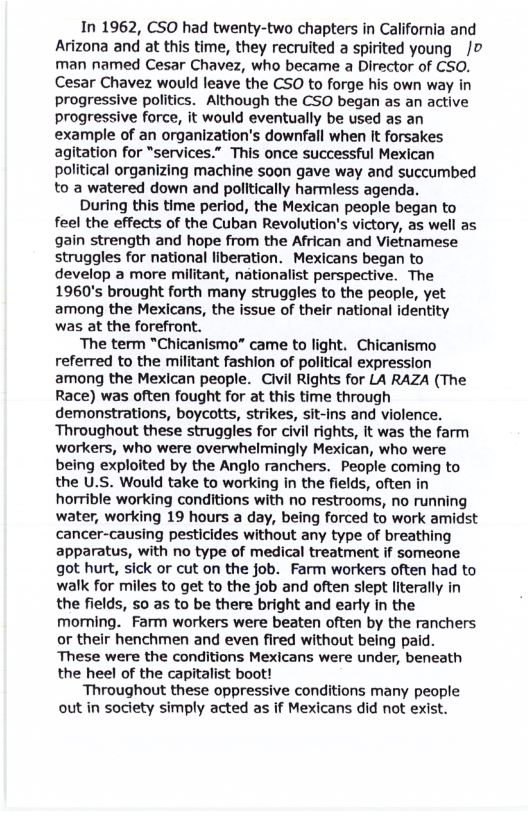
“When Revolution Calls”
In 1962, Cesar Chavez began work organizing the farm
workers. This organizing would lead to the formation of
the National Farm Workers of America ((NFWA). This
freshly organized union announced its presence to the
country by a strike of grape pickers on September 16",
1965. A boycott of grapes caught on throughout the
country, one of the few times a boycott was effective.
On March 17, 1966, a march on Sacramento began
and out of this march came the creation of the "Plan de
Delano” which was a rallying cry for justice. The Plan de
Delano was a six-point plan and it was the most effective
propaganda statement of the time. It became a focal point
that brought all the Brown masses together for a common
struggle, whether it was a Mexican from Chicago or an
urban Mexican from the East Coast, who never even met
anyone who had worked in the fields, It brought all Brown
people together to support the cause o the farm workers.
Chavez's group came to be known as the United Farm
Workers (UFW) and it raised the living standards of
Mexican farm workers. Cesar Chavez was to the Mexican
cause what Martin Luther King was to the Civil Rights
Movement.
In the middle 1960's, the "Crusade For Justice” was
founded. The Crusade For Justice was another organizing
factor for the heady swirl of that time. Crusade was
organized by Rudolfo “Corky” Gonzalez. Corky was a
leader of the Mexican community at that time. He was a
former liberal Democrat who broke with bourgeois politics
to take on the exploitation of the Brown community and
was the strongest advocate for “Chicano Nationalism.”
Corky came from the barrios of Denver, Colorado and
was a well-known boxer there. Thus, his organizing ability
was readily accepted amongst the barrio youth, college
students and the ex-inmate population. The discarded and
those castoff from the system, flocked to Corky's banner
and accepted his leadership- in the Brown community.
Crusade For Justice had campaigns against police
brutality, for civil rights, an end to discrimination in the
schools and offered cultural programs. It was a single base
organization which was well-organized and managed to
develop its own sources of funding. Crusade's aims were
for self-determination for the people of Aztian (Mexicans.)
13
'
Crusade was considered more progressive than previous !
organizations, as its focus was on independent institutions
for the people, outside of U.S. Government involvement.
Crusade had an excellent school called *Tioatelolco”
which is a native Aztec word in their Nahuat! language
which means “school.” The purpose for the Tlatelolco was
to boycott the U.S. school system as it was discriminatory
and taught racist versions of history to Mexican children.
So the people formed the Tlatelolco to teach Brown
children the real uncut education.
Another achievement of Crusade was its newspaper
called "/ Gallo” (The Rooster.) El Gallo would bring the
unbiased news, untainted - straight to the barrio. When
the police violated the peoples’ civil rights, £/ Gallo would
let you know about it. When the people attained a victory
or planned a march or boycott, it would be in print. E/
Gallo was our newspaper! Crusade was very progressive at
that time. It's work was to organize and mobilize Mexicans
and it did so while denouncing the U.S. Government's
whole system.
From 1968 to 1978, Crusade was highly active and
provided the Mexican people with national leadership for its
progressive elements. Crusade would thus soon become
targeted for police harassment and disruption. Support
from the people would then slow down and internal splits
created by “law enforcement” activities would lead to its
demise. This seems to be the pattern with most groups
being discussed, and that is because once these groups
gained some momentum and began to genuinely empower
the people, government agents would infiltrate the group
and create chaos. So, once these groups were targeted,
the people who are the social base of their support, would
disperse and back away, leaving them to die. The lesson
here is once a group is targeted, this is when the people's
support is most needed. This is when people must find
ways to survive and be most vigilant for the many traps
and crafty, underhanded dirty work of the agents of
repression.
s
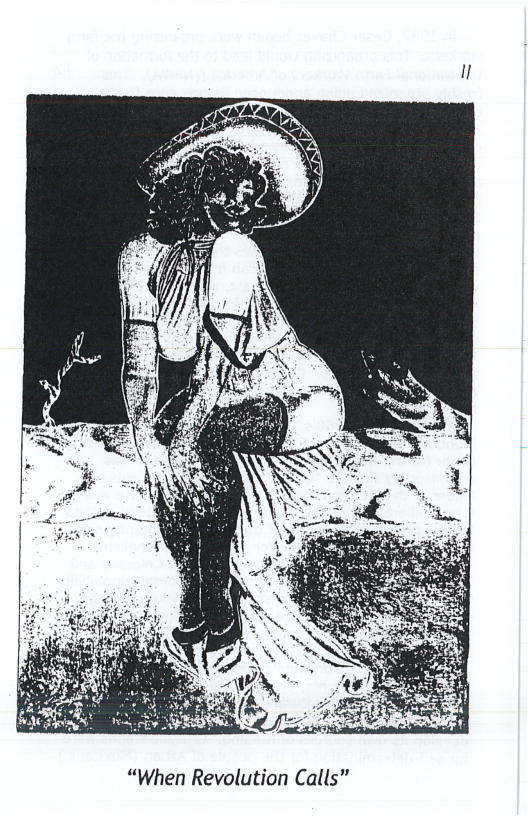
“Lady Liberation”
1t
In 1962, Reies Lopez Tijerina organized the "Alianza
Federal de Pueblos Libres” (Federal Alliance of Free
Nations) in New Mexico. Tijerina came from an immigrant
family. ‘Growing up, he was a Protestant practitioner, who
in his early adulthood broke with religion to take up the
Mexicans' struggle.
Allanza took up the struggle to retain or maintain the
fand that had belonged to Mexican people in New Mexico
for centuries, even before the U.S. takeover of this area
that was once part of Mexico.
The Treaty of Guadalupe Hidalgo guaranteed that the
Mexican people could continue to own their land which
combined total was in the hundreds of thousands of acres.
These land grants, however, were not honored.
Alianza led the fight for Mexican and First Nations
(Native) people who had been run off their own land as
well as the right to thelr culture and language, which
helped to develop the struggle for nationalism and self-
determination. Alianza began to take measures that would
get their issues into the courts so that the Treaty of
Guadalupe Hidalgo would be honored. This reliance on the
imperialist's court system was on of Tijerino's first mistakes
as the U.S. Injustice system is a tool used to enforce
exploitation on the oppressed nations and will never give
up part of its stolen territories just to *make right.”
Nonetheless, many efforts were made for the struggle to
reclaim the land for the people.
One such incident occurred on October 15" and 22* of
1966 at the Echo Amphitheater, which Is located in the Kit
Carson National Forest. Alianza occupied the
amphitheater on these dates to display the rights of the
people to their land. During this operation, a Forest Ranger
was taken and “tried” for trespassing on the peoples' land.
His forest service truck was impounded by the people.
These were the kinds of things Alianza was taking up, for
this was the political environment of that time.
‘The incident that gamered the most publicity occurred
on June 5%, 1967. On this day, Alianza conducted a raid
on the Tierra Amarilla Courthouse, where citizens and a
District Attoney were taken into “custody” by the people.
5
The officials were "tried” by the people and found to be
quilty of occupying Mexican land and private property. This
was then broadcast to all the American media stations.
Just think of the response from the imperialists! *The
audacity of those Mexicans using our courts to charge us
with a crime!”
Such an incident no doubt boosted the morale of the
Mexican struggles nationwide. Tijerina was hit with a slew
of charges. He went to trial and represented himself. He
was acquitted on the state charges of kidnapping and of
assault with intent to commit murder. In a subsequent
federal trial, Tijerina was convicted of destruction and
assaulting officers and spent about 2 ¥ years in federal
prison. Once out of prison, Tijerina seemed to slow down
his activism. His supporters dwindled as did those for the
Alianza. Allanza would soon deteriorate after being
targeted by government agencies and attacks by bourgeois
Mexican liberal, democratic “leaders.”
In the mid-sixties the Mexican student movement
exploded on college campuses. This movement was a
combination of civil rights, strong cultural nationalism and
a slight slant towards Marxism. Afthough there were many
student groups arising at this time, in 1969 most of them
would consolidate under the name of £/ Movimiento
Estudiantil Chicano de Aztian” (MECHA) which in English is
the Chicano Student Movement of Aztlan. Mechas initial
stance was to reject assimilation and to promote Mexican
culture and civil rights for La Raza In a militant fashion, It
would soon become another victim of state repression and
manipulation. It's activism was weakened but not before it
had a chance to influence other students and people in the
Mexican community to take a more militant stance for the
Brown struggle.
‘The late 60's gave birth to the Brown Berets. The
Berets were the essence of milltancy for La Raza. The
Brown Berets grew to over twenty chapters and had an
excellent newspaper called "La Causa. " The Beret's focus
was on self-determination of Raza and independent
institutions to serve the people. Their paper, "La Causa”
was at the front lines in news reporting in the barrios. This
was our voice in the community. The Berets had a health
/7
20
care clinic it maintained where the people received free
heath care. Yet the primary focus for the Berets was on
self-defense in the barrios, be that from the police brutality
or any other forces. The Berets were comprised of male
and female members.
They had a ten point program that addressed issues of
employment, education, culture, housing and justice. The
Berets were a highly disciplined group who struggled to
develop unity and most Importantly, consciousness
amongst La Raza. Any major political event of the time
saw the Berets there to support the interests of the people.
At one point, the Berets promoted the occupation and
symbolic liberation of Santa Catalina Istand which they
claimed was sovereign Mexican teritory. Because of their
militancy and struggle for La Raza, both ideological as well
as physical struggles to uplift the mindset of the people,
the Berets encountered extreme harassment and targeting
by the intelligence programs such as COINTELPRO (Counter
Intelligence Program.)
The Feds infiltrated the Berets and created internal
factionalism while at the same time launching negative
publicity (smear campaign) against the Berets which were
all heavy blows to the groups. They disbanded in 1972,
but have recently regrouped and taken up the struggle,
once again.
Although most groups started out with progressive
natures, only a couple refrained from becoming liberal
ethnic organizations. To take a historic look at the
struggles waged in those times, we see that state agencies
always seemed to take these groups down right at their
strongest points, imprisoning the leaders or assassinating
them. And for many groups, there was this cult of
personality where the people followed a certain leader. The
leader became imprisoned and the people gave up.
The people need to take a critical analysis even of its
leaders because the leader can very well end up the reason
for the demise of the group.
We need to decolonize our minds and realize that we
are a force to be reckoned with. We come from a long line
of revolutionary fighters and liberators, from Emiliano
Zapata who inspired the Mexican peasants to rise up and
break the chains of the large andowners, to Pancho Villa
Y
22
Wwho also helped the Mexican people to topple the corrupt
government, to Ricardo Flores Magon, who was a
revolutionary writer who helped build public opinion in the
first place to create these revolutionary movements for
“Land and Liberty.”
Let us not forget freedom fighters like Joaquin Murrieta,
who sought supreme justice in California during the Gold
Rush and fought the abuse of Mexicans. Tiburcio
Supremacy formed a miltia in the 1850's to fight white
supremacy. Basillo Ramos created the "Plan de San Diego”
in 1915 in the state of Texas. This was a call to arms and
involved a coalition of Mexicans, Blacks, First Nations and
Asians to take up arms against white supremacy. These
are some of our freedom fighters who came before us.
They fought the same struggles we are still faced with
today.
‘The Aztlan that so many fought and died for, continues
to glimmer on the horizon. It Is the people's will to regain
a foothold in our sacred land and break the chains that
colonize our minds. It is time to rebuild the revolutionary
spirit in our community and resuscitate our independent
institutions. Raza stand up! For, we are on the quest for
Aztian!
Tierra y libertad
Jose Heladio Villarreal
11 - 2- - 2008
ture of Aztlan
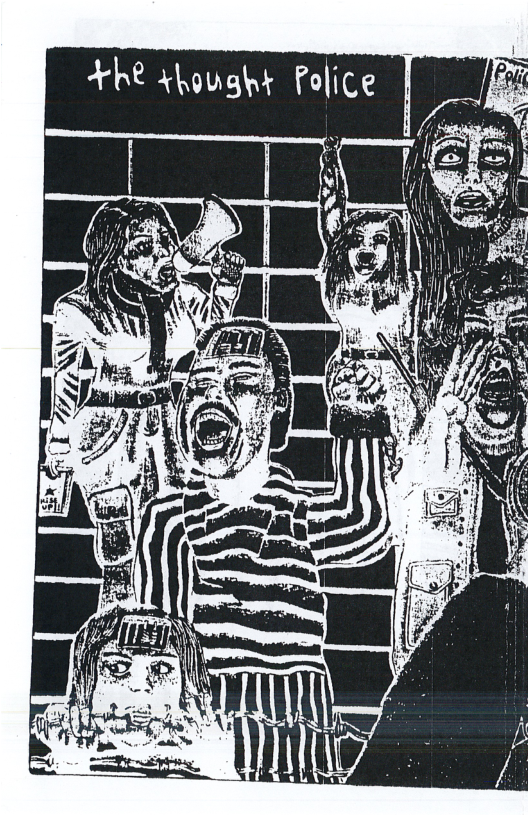
+he thovabt Police |
“Toltec Nights”
ndient Artist”
A
>
St vilwRénl
FASP-¥ HOUOQP.
7080X 7500 g
CRescEnT CH, cA
ags3z
3¢
The Starvation of Pelicans
The recent developments here in California’s Pelican
Bay State Prison has injected new breath into the
importance of prison organizing in today's world of the
Supermax. Being one of the participants, I felt it befitting
to touch on the wind sweeping California’s bloated prison
system.
On July 1* 2011, a hunger strike was initiated here in
Pelican Bay's Security Housing Unit (SHU.) This hunger
strike was created as an act of civil disobedience - a non-
violent protest that resisted the brutal treatment and
torture that has occurred here, as well as in all the
Supermax prisons all across Amerika. The effort that was
spearheaded by prisoners here in the SHU, has snowballed
into a statewide action, involving thousands of prisoners in
other prisons across California.
But what exactly causes someone to deprive oneself of
food, the essential nutrient that allows one to continue
living? We all know the “dog eat dog” society we live in
under capitalist Amerika encourages profit above people's
rights, but what causes prisoners ~ those considered the
cast-offs of society (especially those in one of the most
brutal prisons in Amerika) to rise up in what can be seen as
a modern-day slave uprising and dare ask for human
rights, to have the audacity to refuse to be tortured? For
this, let's take a closer look at what got us to this point.
History of California's Supermax
California, taking a page from the Federal prison :
system's playbook, began in the 1980's to design Security
Housing Units (SHU) that were meant to isolate certain
prisoners from the general prison population and confine
the targeted prisoners in supermax prison facilities. What
was supposedly meant to be for “safety and security” of
the institution, quickly began to be used for the cruel and
sadistic enjoyment of the guards. Indeed, most of us
remember the horrors of Corcoran SHU where it came out
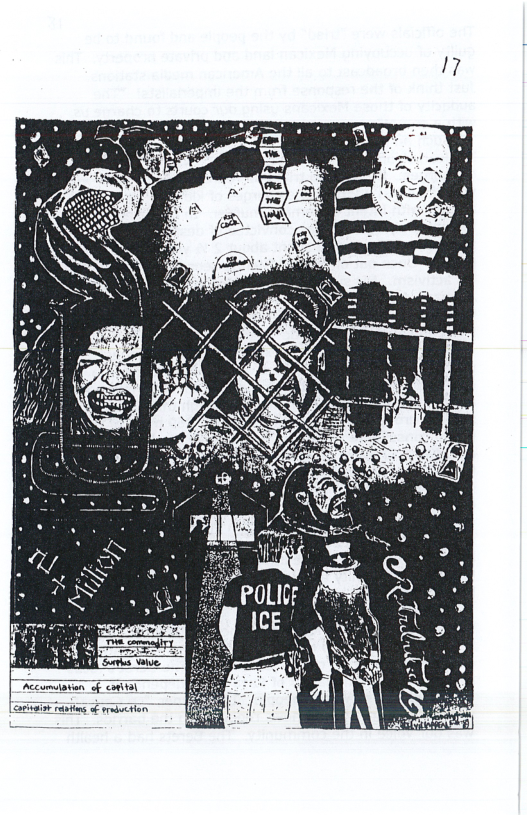
“Amerika’s Dirty Secret”
that guards would pit prisoner against prisoner in gladiator
style fights and then shoot one or both of the prisoners. It
came out that the guards were placing bets on the 37
prisoners on who would win. Other prisoners were placed
in cells of known brutal rapists out of anger, maybe a
certain prisoner pissed off a guard, so off he went to a
rapist's cell. All kinds of depravity came out of the
Corcoran SHU incident but Corcoran SHU was not the
exception. In fact, the California prison system as a whole
has been festering for decades.
1 remember personally being in the “hole” in Pleasant
Valley State Prison in the mid-1990's (Pleasant Valley is
known as a ‘general population’ prison) and in the hole the
guards would set up these gladiator fights and I remember
every morning the guards would announce yard time by
getting on the microphone and yelling at the top of their
lungs “Get reeeeeaaaady to rumble!!11" like the old
wrestling announcer for WWF. Then, the prison
administrators, e. Assistant Warden, Secretaries, etc., etc.
would walk through in suits with (and this is 100% true)
bags of chips, popcom & snacks and sit up in the watch
tower to watch as we were taken out of our cages and led
out to the coliseum for gladiator style fights. This was
going on throughout the prison system on a large scale but
this abuse was externally administered and as horrible as it
was, it physically only lasted a designated time frame.
What came to be even more horrendous was the supermax
units that were unleashed on California prisoners. The
abuse that came with the SHU was often unseen abuse,
often psychological abuse on a major scale.
Currently, California has four Supermax SHU's -
1) Tehachapi SHU, 2) Corcoran SHU, 3) The Medical SHU
at Folsom and 4) Pelican Bay SHU. By far the most brutal
has been the Pelican Bay SHU where prisoners face all the
abuses of the other California SHU's but also, unique to
Pelican Bay, is that prisoners are subjected to solitary
confinement for years. Solitary confinement has been
described by the political prisoner, Luis Colon Osorio, the
Ruerto Rican alleged Machetero as “white torture” because
this torture leaves no physical scars. Pelican Bay is unique
in many ways, so let's dig deeper into the Pelican Bay SHU
itself and examine what it is and how is life inside this
house of horrors.
4o
The Control Unit at Pelican Bay
The Pelican Bay SHU is located as far north in California
as one can possibly get for a prisoner. It is located about
30 minutes from the Oregon border amidst the forest.
Most of the families of prisoners housed here, live
anywhere from 600 to over a thousand miles away! This
prison was opened in 1989 and cost the taxpayers $277.5
million to build. Although there are more than 3,000
prisoners in the entire prison (general population Included)
more than 1,000 are confined to the SHU which is pretty
much a prison within a prison that has its own electric
fence and its own prison administration. During the time
that the Pelican Bay SHU has been 'open for business'
there has been multiple attempts to stop the torture that
goes on from lawsuilts, protests, articles, etc. to stop the
abuses that have gone on over 20 years now - to no avail.
The SHU was designed to break prisoner's will to resist
abuse, to not dare raise one's eyes to the captor. It was
designed to use all methods of deprivation to make life in
the SHU so unbearable that prisoners would do whatever it
took to get out of the SHU. For those of us in SHU, life
becomes a constant battle to retain morals and defy being
forced to do the bidding of our oppressor. The SHU
experience means being locked in a windowless concrete
cell for 22 ¥ hours a day, every day. These cells face a
plain white or off white concrete wall so that when we look
out the front of our cell all we see is a blank wall all day,
every day. The front of the cell is a mesh type door and
wall so that when guards do counts, they can see into our
cells. The noise level is pitch quiet but we can also hear
every cough, sneeze, laugh, yawn, etc. from everyone in
the pod, all day, every day. This gives the impression of
having no privacy even when totally isolated and tends to
annoy people to the point of extreme frustration and
agitation.
One never has physical contact with another human
being, as long as you are in the SHU. For all movements to
medical, etc., you are taken out in the pad in front of the
whole pod and strip searched, then chained in waist chains
Yz
and taken by guards. The yard consists of a dog run style
space that's approximately three steps wide and ten steps
long, where one is free to walk in circles for an hour and a
half. We get no direct sunlight in SHU, no phone calls, no
contact visits from family or friends and are housed in
solitary confinement.
Reading material is heavily censored. Here, any kind of
political theory is often forbidden. We are even forbidden
to have any books or literature on Indigenous languages,
even if we are Indigenous ourselves! Most prisoners here
are Mexican and yet being in possession of Mexican
Indigenous languages is forbidden and used to show you
are in possession of “gang-related material.” Revolutionary
figures like Che Guevara, Emilio Zapata, Pancho Villa or
Gearge Jackson are forbidden as the prison claims this is
“gang material.” The political repression is akin to any
colonized people where one's language and history are
forbidden and replaced with the colonizers language and
history.
Prisoners who may be fortunate enough to have a
family who might come into the SHU, are often stripped of
this rarity because of the distance of this prison from their
loved ones and the fact that the family must travel so far
for a one hour visit, where they must stay behind a thick
glass window and cannot even touch one's own family. The
cruelty and painfulness of this situation is often too much
for most, this and the fact that one's family must watch
their husband or son deteriorate under such cruel
circumstances. The family unit is broken up for most men
in the SHU and this works to further the psychological
trauma that prisoners will experience in the SHU.
There are currently just about 2.4 million prisoners in
Amerika today! Amerika has more prisoners than any
country on the planet at any time in historyl The epicenter
for Amerika's mass incarceration is the state of Callfornia.
The U. S. Supreme Court has recently ruled that California
prison conditions are “cruel and unusual punishment” and
has ordered California to lower its prison population, The
Supreme Court found that about one prisoner dies per
week in California because of lack of medical care. Here in
the SHU, medical services are next to impossible to get.
“Prison Censorship”
Say you should get sick with a fever. You'd have to put in a
slip and it will then take a few weeks for you to be called 44
and seen. By then, you won't be sick any longer - or alive!
Those who have known ailments are refused medication
and surgeries are next to impossible to receive. People are
told to “debrief” (snitch) i order to receive care.
Prisoners out of anguish roar up on staff are prey for
the “cell extraction” teams which are the brutal goon squad
that comes in the pod like a football team with football
helmets on, knee pads, clubs, boots and shields and by the
time they get done with you, you will not be walking out of
your cell.
The brutality inflicted on the SHU population is a
control tactic used to terrorize SHU prisoners into
submission. The environment is one of constant repression
and deprivation. At all hours, pods are undergoing “pod
raids” where guards run in, turn off the water and conduct
cell searches, tearing up one's cell, confiscating books,
legal work or anything else that the guards don't like or
feels will irritate the prisoner. It is a constant harassment
meant to agitate and stress out the prisoners who have
less than human rights as it is. This heightened repression
is even unleashed by the meals being served as they are
skimpy, bland and as unidentifiable as possible.
The ability to correspond with one's family is even
scrutinized with overwhelming mail disapproval slips
handed out and mail denied for everything from a letter
having perfume on it, glitter or supposed gang code talk.
But how can we challenge this when we are not allowed to
even examine the letter?? And, isn't anything open to be
considered a supposed “gang code talk??” These types of
loopholes give not just the ability for repression, but make
it easy - and even standard.
“She of the Serpent Skirt”
46
What Sends One to the SHU
The reasons one ends up in the SHU vary. It could be
someone who is a prison “jailhouse lawyer” who files
lawsuits on behalf of prisoners to attempt to attain their
rights. It could be a prisoner who holds revolutionary
opinions. It could be a prisoner with Influence or a prison
organizer who initiates strikes in prison. Maybe the
prisoner has a past history of fighting with prison guards or
is a mentally ill prisoner who can't be controlled on the
general population. Then again, it could be a “gang
member” or one of their associates.
An informant can implicate someone as a “gang
member” or associate and whether this information is true
or not s irrelevant. For, this can send a person to the SHU,
S0 if a prisoner gets on the wrong side of another and he or
she happens to be an informant, one can end up in the
SHU.
This implication for SHU is the same as the system used
to send people from Afghanistan to Guantanamo Bay,
where people have told on their neighbors sometimes out
of spite. They accuse them of being a “terrorist” and they
get kidnapped and sent to Guantanamo Bay and
Questioned later. Well, it is the same for SHU prisoners
who are kidnapped off the general population and sent to
the SHU. The supposed “due process” right does not apply
as one cannot even face the accuser or challenge the
assertions because it's considered “confidential.” Thus, you
cannot even be told what you have been accused of!
The plan to place prisoners in SHU has been well
thought out and for decades it seemed, there was no way
to remedy this attack of Brown and Black prisoners. The
majority of SHU prisoners in California are Latinos. The
majority of prisoners in California are Latinos. The
majority of Federal prisoners are also Latinos. The
message is clear and should be understood by all who seek
justice and human rights to see that the attack is on poor
people in general, but Latinos in particular. The repression
is real - about as real as it gets.
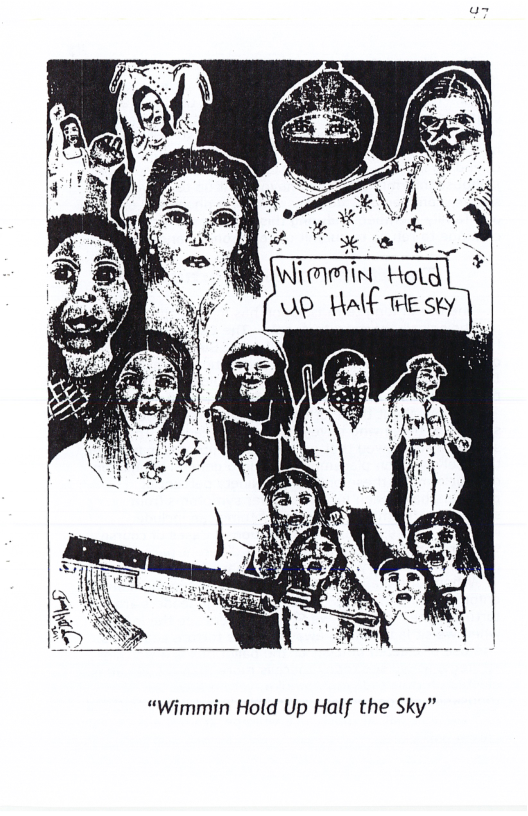
“Wimmin Hold Up Half the Sky”
ki
The only way to get out of the SHU and back out to the
general population is to parole (if you have a date), snitch
or die. These are the only ways to escape the torture
chamber known as SHU. The propaganda disseminated by
the state says we are the “worst of the worst” yet most
have never even committed any physical crime o infraction
to end up in SHU, rather, most end up here due to
jailhouse informants. Some have spent up to 40 years in
solitary confinement, decades without a phone call or touch
of a family member, enduring this endless repression and
continue to refuse to submit or compromise another.
The Effects of SHU Torture
The use of long term isolation has long been known to
psychologically harmful to people. The European Court of
Human Rights had a doctor testify that Supermax Prisons
caused panic attacks, psychosis to emotional breakdown.
Indeed, all studies showed these psychological symptoms
to develop after only sixty days of such detention!
So how about those of us who have endured years? Or
still more, those who have undergone decades? The
studies also showed that once these symptoms manifested
themselves, even placement back into general population
did not remedy these problems. Ninety percent of
prisoners have been found to suffer symptoms from
solitary confinement. These symptoms can include
insomnia, confusion and hallucinations. Cases of course
vary and prisoners are affected at a different pace but all
can agree - solitary confinement is harmful.
When Amerika invades foreign countries in the name of
enforcing human rights or because foreign leaders are
torturing their citizens, we SHU prisoners see the irony
when we sit languishing away in these torture chambers,
The use of elected officials or the ballot box Is a worthless
strategy, as we see today there is more than 6,000 Latins
elected officials today in Amerika, yet here we are
thousands of poor people, Latinos included, being tortured
and we hear not so much as a whimper from the bourgeais
Latino politicians.
“The Thunderbird Flies”
so
So, within this struggle for human rights, T think the
people need to also separate the wheat from the chaff as
far as a vanguard is concerned and come to the realization
that the people will have to find ways to change society.
We need to have the ability to see the future is changing
and we must constantly find ways to harness these
changes to advance the struggle.
The five demands or five points for the hunger strike
are: 1) End group punishment. This is in reference to the
way prisons in California routinely lock down an entire
group for one person's actions, so that all Latinos can be
locked down (hundreds) for the action of one person. This
goes on throughout the prison system for months at a
time.
2) Abolish “debriefing.” This is in regard to stop snitch
or die campaign the state has initiated. 3) Comply with the
recommendation from a 2006 U.S. Commission. This is in
regard to the solitary confinement in SHU. 4) Provide
adequate food. 5) Expand and provide constructive
programs and privileges. This is calling for art supplies,
self-help treatment, education, phone calls, photos, etc.
At the time of this writing, history will show if the state
agreed to give basic human rights to prisoners or if the
disregard continued. Where most have life in prison, relief
of any sort would no doubt be welcome, as what can be
worse than a life of torture?
I have these last past weeks remembered photos of the
oil spill in the Gulf of Mexico showing a pelican drenched in
oil, unable to eat or drink. The photo of the starvation of
pelicans seems to come to me especially when prisoners
suffer their own disaster here in SHU. We are not beasts,
we are the people! We have, in the tradition of Attica, cast
off the chains that bind us and for a brief moment, we are
freel We no longer accept the lash. We raise a clenched
fist and refuse to be tortured! Peoples’ Power Siempre!
Jose
7-20-11
Jose H. Villarreal #H84098
PBSP - SHU - C111 - 106
P.O. Box 7500
Crescent City, CA 95532
“The Harvest of Freedom
South Chicago ABG
Zine Distro
P.0. Box 721
—
Homewood, IL 60430